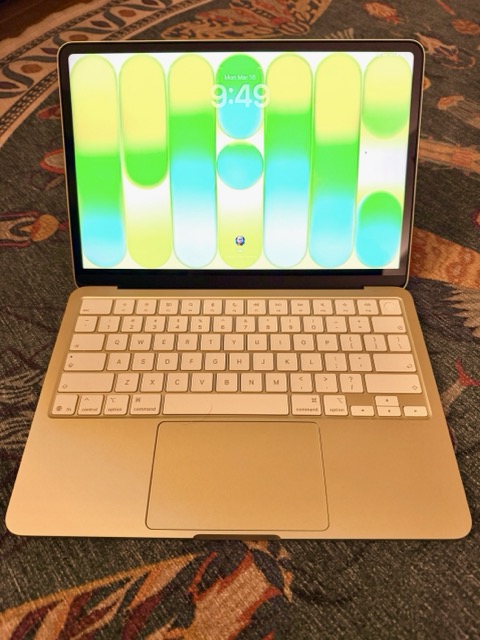
Cheap MacBook Neo Review
The latest computer released by Apple is not a computing powerhouse, a technical marvel, or the latest and greatest piece of technology. However, it received a lot of attention and critical acclaim because of one key feature. Marques Brownlee recently called it “Apple’s most disruptive product in the last 10+ years.” The annoying feature is the price. Starting at $599 (or $499 for education), the MacBook Neo is the cheapest MacBook ever produced. This put traditional PC laptop manufacturers on alert and stunned the industry. How could Apple design such a rugged, high-performance, attractive machine for that price? Knowing Apple’s history of hardware margins, production costs must be very low. Intrigued by the value proposition and wondering if this model would fit my specific computing workflow, I purchased the Citrus 512GB model on day one.
My Computing Lifestyle
To provide context, my “computing lifestyle” relies on a few key machines. When working from my home office, my daily driver is a Mac mini (M4 Pro). For tasks outside the office, whether elsewhere at home or traveling, I rely on my 16-inch MacBook Pro (M4 Pro). For light tasks that don’t require a full macOS environment, I use a 13-inch iPad Pro (M5) and an iPhone 17 Pro Max.
Over the years, I’ve moved further away from an iPad-only lifestyle, and increasingly favored the powerful macOS environment for almost everything. While the iPad’s hardware remains excellent, iPadOS (even with the latest iteration of the windowing system) still lacks the smooth, unrestricted productivity of the Mac. So where does the cute, budget-friendly MacBook Neo fit into this complex and comprehensive ecosystem? Turns out, right in the middle.
Cigar Room Computers
Apart from my daily work, I also often like computers. My side projects include iOS app development, smart home development, 3D printing, and general technology testing. Since I don’t have a “personal” laptop specifically for these tasks, I have the luxury of using the office-provided MacBook Pro. However, these technological adventures usually take place in the cigar room adjacent to my house (also known as the garage).
Computers inherently absorb their surroundings, quickly absorbing the characteristic odors that come with spending several hours in a cigar lounge. I have been actively looking for a “smoking computer” specifically to prevent my work machine from smelling like an ashtray. The MacBook Neo seems to fit your needs perfectly: small, very portable, very cheap, and functionally capable.
Hardware and Performance
After opening the box Orange colored 512GB SSD A MacBook Neo model, taking a moment to appreciate the striking colorway, and running through the mandatory day-one updates, I was off and running… or rather, walking slowly.
I immediately started installing my basic set of utilities and applications: Alfred, Slack, Xcode, TextSniper, Paste, iStat Menu, And Microsoft Office. This initial setup phase clearly explains the hardware limitations of this entry-level machine.
Copying, moving, and deleting files, including the application installation process itself, proved to be very slow. The storage bottleneck is almost reminiscent of the era of spinning platter hard drives. Additionally, memory management is aggressive. Opening Safari with just three tabs, with no other active apps, quickly used up the standard 8GB RAM. Once that threshold is exceeded, the system will rely on the swap file. Because the swap file is reverted to a slow SSD, the performance degradation is very pronounced across the operating system.
The trackpad also presents a significant regression. The Neo doesn’t feature the haptic, stationary Force Touch trackpad found on every other modern Apple computer. Instead, it uses an old-style physical diving board mechanism. While this may not sound detrimental in theory, the physical sensation and hollow “click” becomes very annoying after years of receiving haptic feedback.
Final Thoughts
The MacBook Neo is an excellent laptop for a large demographic, especially students, seniors, and Mac-curious Windows users looking for a low-risk entry point. Unfortunately, this isn’t the right computer for me. What I need from a secondary “toy” computer is more computational oomph and less emphasis on pure affordability. The MacBook Air is probably better suited to a very specific slot and is arguably unnecessary in my hardware lineup.
My time with Neo was enjoyable, but it introduced a level of system friction that I didn’t want to sustain. The aspect of Neo that I miss most is the aesthetic. While one is drawn to various shades of green, Apple is really into the Citrus colorway. This is equivalent to the Cosmic Orange introduced in the latest iPhone 17 Pro line.
The good one
- Price: A great value at the $599 entry level, even considering the performance hitches.
- Quality: The chassis feels sturdy, solid and premium. Without prior context, one could easily assume that this is a $1,000+ machine.
- Color: Breaking from the standard silver, space gray, and rose gold, the bright Citrus option is a fantastic addition.
- Screen: Exceeding expectations for a budget device, the 13-inch 2408×1506 resolution (resulting in 218 pixels per inch) qualifies as a sharp Retina display.
- Size: At just 0.5 inches thick and weighing 2.5 pounds, it matches the ultra-portability of the MacBook Air, albeit with a slightly smaller screen.
- Improvement: At just a $100 premium over the base model, doubling the storage to 512GB and adding Touch ID is a highly recommended 17% price increase.
- Battery: Thanks to the efficiency of Apple Silicon, the battery can easily last all day and beyond, mirroring the iPhone’s durability.
The bad one
- SSD Speed: The data transfer speed is very slow, which has a negative impact on application installation and large file management.
- RAM limitations: 8GB is easily filled by basic web browsing, so it relies heavily on slow SSD swap memory.
- Track board: The return to physically clickable “diving pad” trackpads feels archaic and rude compared to modern haptic alternatives.
Beard Blog Score: 9/10
Related Posts
PakarPBN
A Private Blog Network (PBN) is a collection of websites that are controlled by a single individual or organization and used primarily to build backlinks to a “money site” in order to influence its ranking in search engines such as Google. The core idea behind a PBN is based on the importance of backlinks in Google’s ranking algorithm. Since Google views backlinks as signals of authority and trust, some website owners attempt to artificially create these signals through a controlled network of sites.
In a typical PBN setup, the owner acquires expired or aged domains that already have existing authority, backlinks, and history. These domains are rebuilt with new content and hosted separately, often using different IP addresses, hosting providers, themes, and ownership details to make them appear unrelated. Within the content published on these sites, links are strategically placed that point to the main website the owner wants to rank higher. By doing this, the owner attempts to pass link equity (also known as “link juice”) from the PBN sites to the target website.
The purpose of a PBN is to give the impression that the target website is naturally earning links from multiple independent sources. If done effectively, this can temporarily improve keyword rankings, increase organic visibility, and drive more traffic from search results.